


Back in 2017, we shared a very extensive posts about light bulbs. One of my favorite subjects. It’s been a very popular post that people ask for a link to all the time except most of the bulbs we shared as favorites in that post are nowhere to be found now! So, we thought it was time to do an updated post on our favorite bulbs with way better visuals 4 years later. Because you can spend all the time in the world outfitting your spaces with cute lights, but if the bulbs aren’t right–what good are they anyway?! Did I lose you? I hope not because truly, the lighting in a room can (and will) make or break the overall look and feeling.
We did a little experiment in Polly’s room switching out light bulbs to demonstrate the difference a light bulb can make. First up, Lumens.

I’m sure you’ve heard about watts, but fortunately almost every bulb has become more energy efficient so while a box will list the watt equivalent conversion, what you should really be looking at is Lumens!
What are Lumens? Watts measure the amount of energy required to light products, whereas lumens measure the amount of light you are getting from a bulb–aha! The more lumens in a light bulb, the brighter the light. We typically buy things based on how much of it we get, right? When buying milk, we buy it by volume (gallons). So, why should light be any different? For decades, we have been buying light bulbs based on how much energy they consume (Watts) — no matter how much light they give us (Lumens). But not anymore. Every box will tell you how many lumens the bulb will put out.
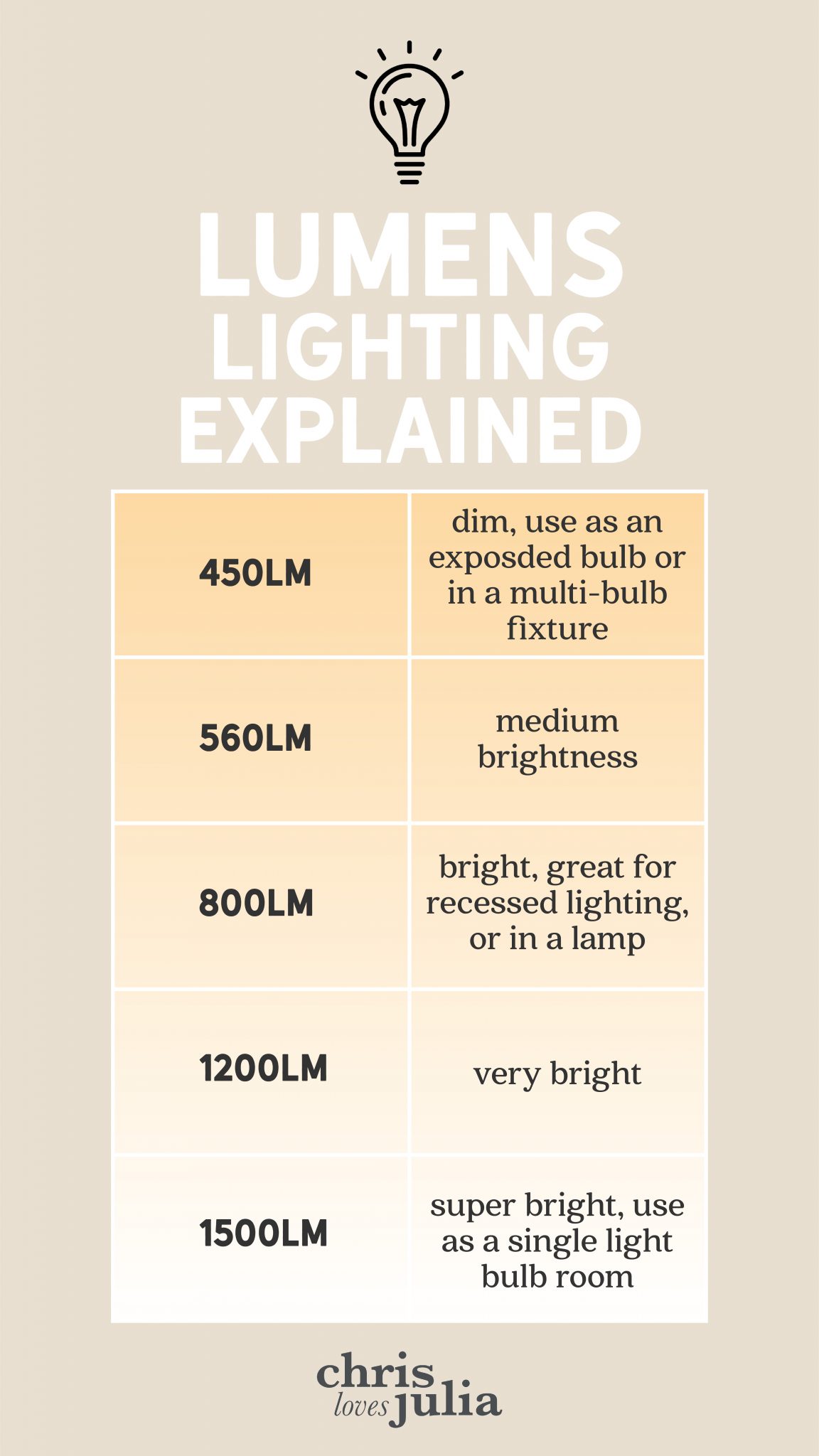
Since the energy bulbs use are now all significantly lower (yay!), it is very important to become familiar with how much brightness you want. We have a great variety of different lumens in our house depending on the use. An 800LM bulb might be great for a lamp in the the corner of the living room, but I like something softer, like a 400 for the bedroom. Or even a 200 for an exposed bulb! Less lumens for an exposed bulb is ALWAYS best.
Which brings us to the next big component when choosing a bulb–Kelvin, or temperature!

You’ve probably noticed some light bulbs look a lot warmer, or orange even (think: typical edison bulb) while some look so blue! That’s Kelvin color in a nutshell and you have power over that. Color temperature is a way to describe the light appearance provided by a light bulb, it is measured in degrees of Kelvin (K) on a scale from 1,000 to 10,000–although typically you’ll find 2000-5000K available in stores for you to buy for your home. The color of a bulb can affect everything from mood of an entire space to the way a paint color looks–it’s really important.

You can use Kelvin temperature to help guide you in determining which fixture is right for each room. Whether you need an ambient source of light or one for highly-focused task lighting, keep in mind the Kelvin ranges from the chart above.

Be sure to check out this reel we posted on Instagram for more of a visual and don’t forget to turn up your volume!
And since this is our blog, I’ll add my personal opinion. To me, “neat, clean, efficient, bright, alert” on the Kelvin scale can translate to “sterile” really fast in your home. I’ve never been into “daylight” bulbs. I play with lumens always, but am pretty strict on Kelvin color. 3000K. Period. It’s clean and inviting without being too warm or sterile. (occasionally I’ll use a 2750K or 2200K for a lamp or just decrease the lumens or both!)
And as an updated source for where to get the mystical 3000K bulb–I get ours at Lowe’s!!! I linked them and the other bulbs we used in this post below for reference. I think most importantly, keep the color pretty consistent throughout your house. I can spot a 5000K bulb mixed with a 2750 a mile away.
2200K – 560 Lumens (for exposed bulbs)




So helpful. Thank you
Hello, I have a new home and new recessed lighting is in a lot of areas – I also put dimmers everywhere needed – the problem is these new LED lights have turned every wall color into RED or PINK??? I need help..
This is the most helpful post I have ever read!! I had a real fear of the light bulb isle at Home Depot before. Thank you so much for sharing your knowledge!
My ceiling lights have been giving me a headache lately, and this guide was SO HELPFUL in helping me to decide what to do about it! I’m wicked excited to go out lightbulb shopping now with this new intel. Thank you so much for the guide!
This post is great – thank you! the target up and up 3K bulb is not available on target anymore. do you have an alternative option?