


This is a post about light bulbs, but I hope the topic won’t turn you off because I’ve learned that lighting has as much impact on a room as paint color or flooring or finishes! Light bulbs have completely changed over the past decade and I’m a firm believer that they can (and will) absolutely change the way a room looks, too. And while I’ve mentioned it several times in our podcast, my stories and as a footnote in posts, I’m a stickler when it comes to bulb color and brightness and I figured it was time to dedicate a post explaining why; It’s all about Kelvin and Lumens.

These lamps both hold our favorite 3000K, 750 lumens bulbs.
First of all, gone are the days where you go to the store and pick a bulb based on watts. Fortunately, almost every bulb has become more energy efficient so while a box will give you a watt equivalent conversion, what you should really be looking at is Lumens!
What are Lumens? Watts measure the amount of energy required to light products, whereas lumens measure the amount of light you are getting from a bulb–aha! The more lumens in a light bulb, the brighter the light. We typically buy things based on how much of it we get, right? When buying milk, we buy it by volume (gallons). So, why should light be any different? For decades, we have been buying light bulbs based on how much energy they consume (Watts) — no matter how much light they give us (Lumens). But not anymore. Every box will tell you how many lumens the bulb will put out.

The chart above shows the number of lumens produced by common incandescent bulbs. If you’re looking to buy a bulb that will give you the amount of light you used to get from a 60-watt bulb, you’re now looking for 800 lumens, etc.
Since the energy bulbs use are now all significantly lower (yay!), it is very important to become familiar with how much brightness you want. Personally, I like around 750-800 lumens for a good shade covered lamp or recessed light, but less lumens for an exposed bulb, like the glass globes in our kitchen–which give off light of 210 lumens and 2700 Kelvin.
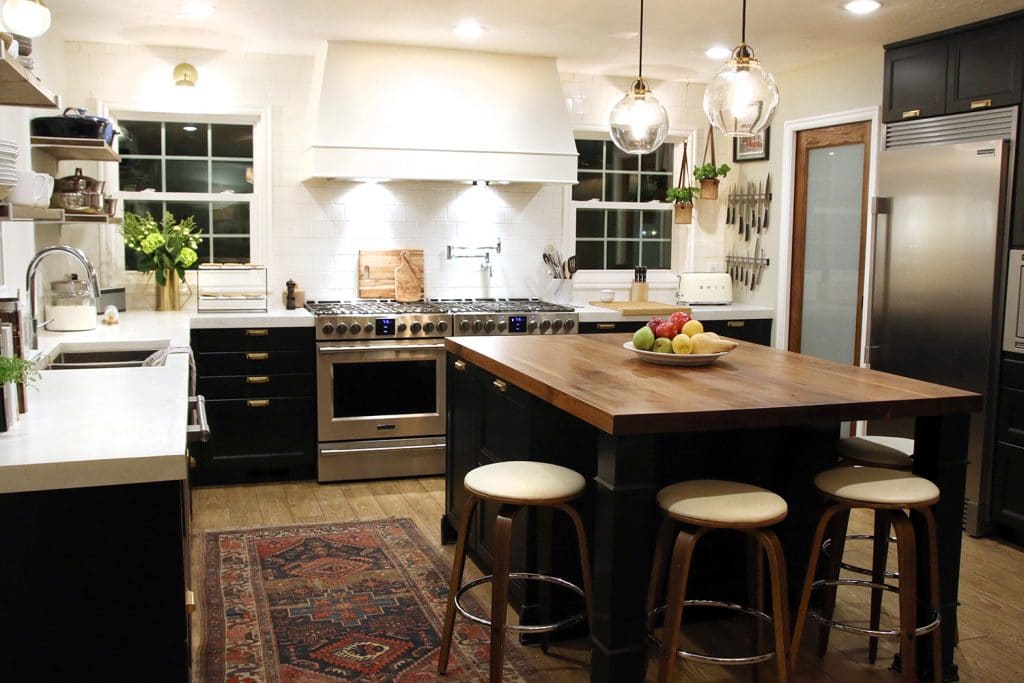
Which brings us to the next big component when choosing a bulb–Kelvin color!
You’ve probably noticed some light bulbs look a lot warmer, or orange even (think: typical edison bulb) while some look so blue! That’s Kelvin color in a nutshell and you have power over that. Color temperature is a way to describe the light appearance provided by a light bulb, it is measured in degrees of Kelvin (K) on a scale from 1,000 to 10,000–although typically you’ll find 2000-5000K available in stores for you to buy for your home. The color of a bulb can affect everything from mood of an entire space to the way a paint color looks–it’s really important.

You can use Kelvin temperature to help guide you in determining which fixture is right for each room. Whether you need an ambient source of light or one for highly-focused task lighting, keep in mind the Kelvin ranges from the chart above.
By using 2 2700K, 650 lumens bulbs in the ceiling in our daughters’ bathroom, we were able to provide a lot more clean light, even in a windowless room! We accented with 2700K, 450 lumens bulbs.

While more than just the lighting changed (obviously), we made the lighting a big part of the design plan, as we do in every room, so the after is a stark contrast from the much more dim and yellowed before:

And since this is our blog, I’ll add my personal opinion. To me, “neat, clean, efficient, bright, alert” on the Kelvin scale can translate to “sterile” really fast in your home. I play with lumens, but am pretty strict on Kelvin color. 2700 or 3000K. Period. It’s clean and inviting without being too warm or sterile.
We love these 2700K, 655 lumens bulbs for our recessed lighting. They’re dimmable and the perfect color with a great amount of brightness. With recessed lighting, you’re generally going to have multiple in a space, so you don’t necessarily need the brightest lumens.
For almost every other lamp or accent light in our home, we love Energetic’s 3000K bulb. It comes in 750 lumens or 450 lumens, depending on our needs.
Here’s a really good 2700K (600 lumens) dimmable edison-looking bulb. (If your bulb is going to be exposed, a good looking bulb is nice to have.)
And here’s a 2700K edison bulb with 210 lumens (similar to what we use in our kitchen glass globes).
I really hope this helps in your own lighting design within your homes. Not only does lighting add so much to the mood (I love our home at night, just as much as in the day because of lighting!), but as I said it also will play a big role in how paint colors look in your space–so make sure you have your lighting right before choosing those other elements.
To see all the lights on in our home, and see how they work together, check out our most recent video tour right here!




I am in the process of replacing the existing lights in my open floor kitchen and I was wondering which color temperature to use. Thank you for sharing your ideas!
3000 k
Great post. Lighting makes such a difference to a space and your thorough explanation of Kelvin and lumens is super. Thanks so much.
Light fixtures typically list max wattage. Do you take this into consideration? I always this was important for fire hazard concerns. Also, any Edison style or pretty bulbs that you know of that give off enough Lumens?
Because almost all bulbs now have converted to LEDs, you will rarely hit max wattage.
Love this .. so previously when choosing lighting I would go with the recommended Watts that the lamp or whatever suggested. With the new energy efficient bulbs does that matter or can you choose whatever bulb that fits the specific lighting you want
Many of your recommended bulbs are no longer available. This is such a great and helpful post, and I hope you’ll consider writing an updated version!!