


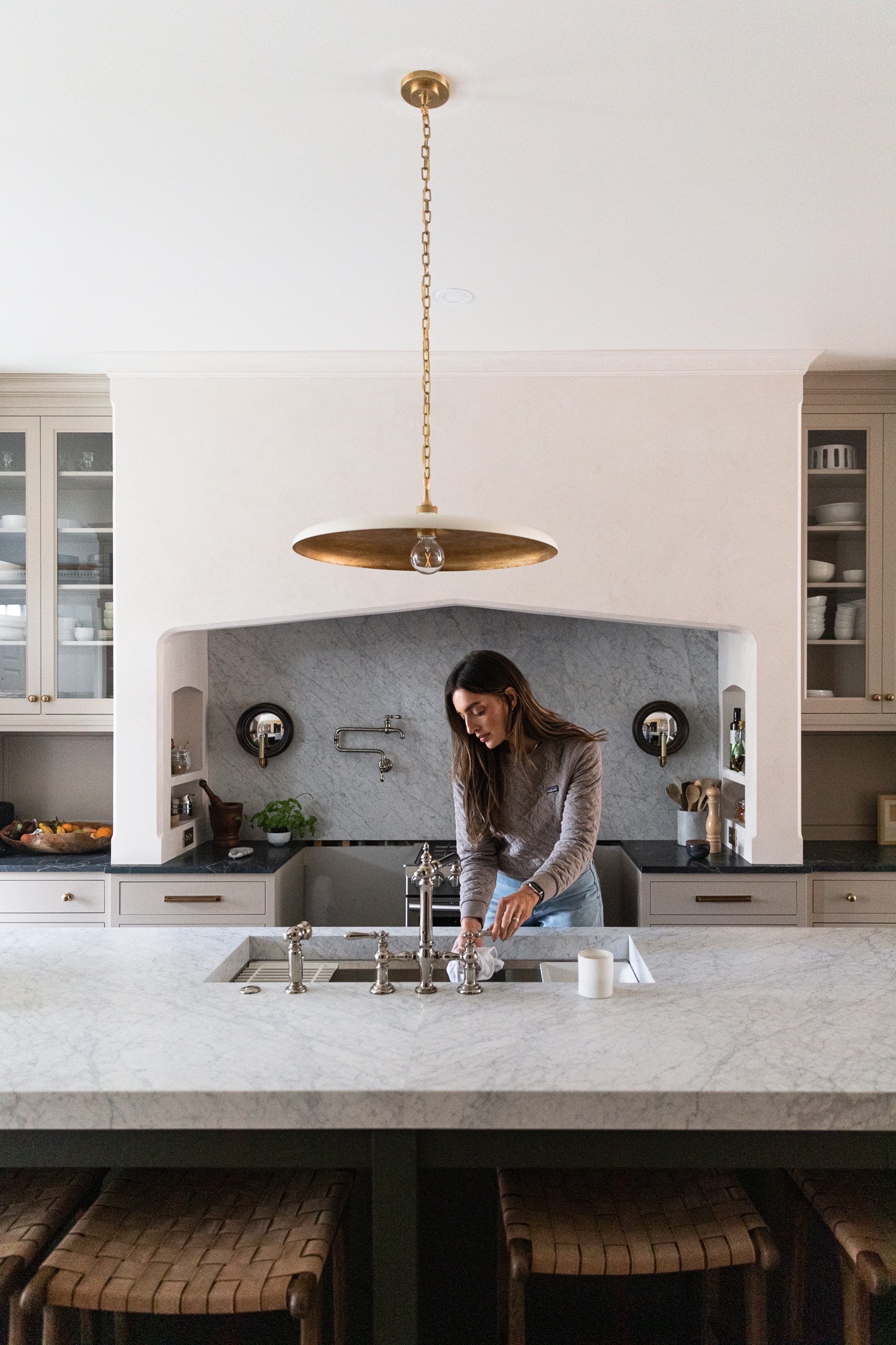
Counter Stools | Pendant | Sconce | Faucet | Sink | Drawer Pulls | Knobs
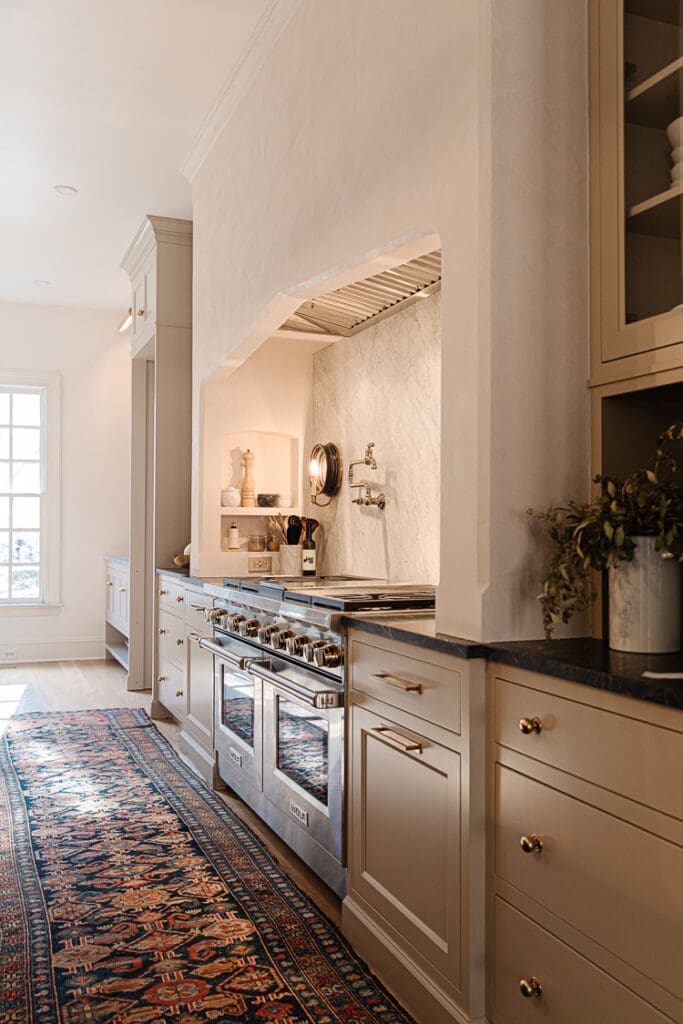
The custom range hood was intended to be a massive design element in the kitchen. The show-stopper and also a sort of resting place in the kitchen. Also, it’s massive in size too! Notice the size of our temporary 30 in range in the photo above for scale. Our 60” Wolf/Sub-zero range should be here this month—fingers crossed. With the amount of cooking Chris does (a lot), we wanted a hood that felt spacious while still stunning. I shared an inspiration picture in our kitchen plans, and Jean designed the most incredible plastered range hood with crown and a chamfered edge.
Of course, I always love going back to the start:

This was the kitchen the day we bought it. When this photo was taken, we actually didn’t have plans of renovating the kitchen yet. It wasn’t until the next day, when we met with our contractors, that we decided to open up the entire space and make it happen. (pst, for context, where the fridge is in the above, is where the new hallway opening is in the photo below).

You’ll recall that one major reason we did all this was because we were doing the floors through the entire house. And since there was a wall we wanted to take out for the kitchen, this was the time to do it so the floors could be seamless through the space. And even though the cabinetry and many details were out several months from when we started, our contractors began putting in place everything they could, starting with the range hood.

We knew this hood was going to be a tricky one. The first approach taken was to frame the entire hood in with dimensional lumber and OSB, covering it all with drywall and finishing with plaster.

But the chamfer on the edges couldn’t be achieved properly this way, so the cabinet installer faced the entire structure with MDF, using a router to create the chamfer precisely.

Because there aren’t MDF sheets large enough to cover the entire hood, they used two sheets, using a biscuit jointer and wood glue to connect the two and sanding smooth.

Unfortunately, we did run into some issues with the seam still showing after a day or so. The contractors screwed the MDF into the framing a few inches apart all along both sides of the seam, it was sanded down, refilled and sanded and plastered again.

Our Plaster Master, Jerry, used an Italian plaster product that is completely wipeable and stain resistant! Incredible. I wanted a color that would be somewhere in-between the white flour paint color on the walls, and the taupe cabinet color to give some contrast but not make it too shocking. I had Jerry tint the plaster to Sherwin William’s Downy.

Here’s the actual product used:

We were able to choose the amount of variation and texture we wanted. And any color in a paint deck to have it tinted to, but it would never be a solid color. That tone would likely be the darkest on the hood and and then lighten up from there as Jerry buffed it. He even applied plaster to the crown to match! It has such a beautiful sheen to it with the perfect amount of movement, really illustrated below.
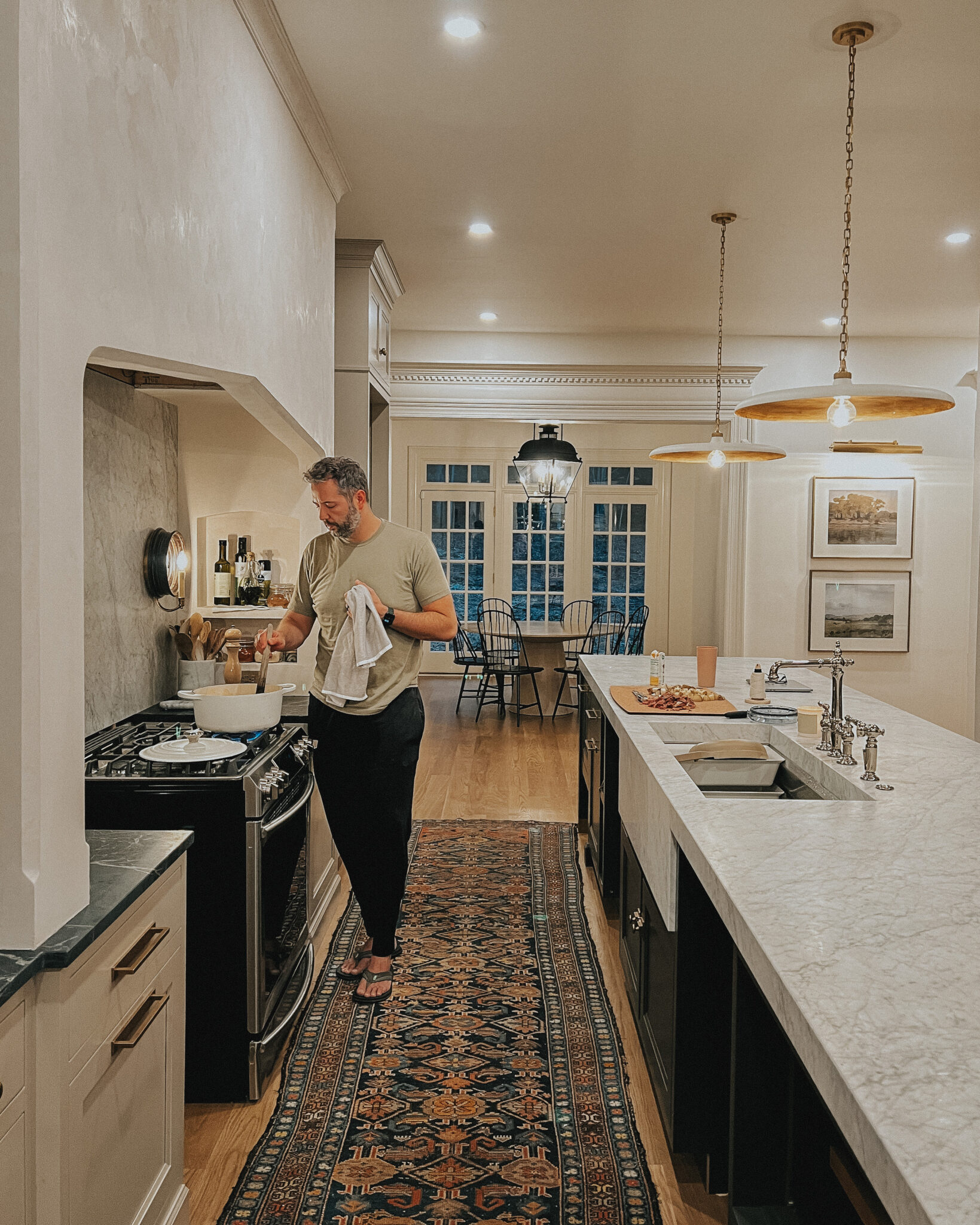
Today

Of course we love it so much, and wish we could say it’s perfect. Unfortunately, if you look closely you might be able to detect a subtle hairline joint where the MDF sheets meet together. Though it’s improved so much, there is still some cracking happening and we’re talking with our contractor about the next steps we should take. The current thought is to route out a shallow channel about 3 inches wide across the seam, span it with seam tape and use Bondo to create a smooth transition that shouldn’t crack with the changing seasons.
In the meantime, Chris has been using his new workspace to its full potential, and every step just gets better and better.
Update March 2025: I posted our thoughts on the range hood after three years, shared dimensions, and answered frequently asked questions here!


Hi, this looks great! Can I ask how tall your ceilings are and the CFM rating on the hood you chose? We are encountering an issue with how low the vented hood needs to sit in order to get maximum flow.
If you ever need to work on the actual metal range hood, how do you access it through the plaster stuff if that makes sense?
If you take off the vents you can access most of the components, but you can also unmount the range hood and take it down completely if needed. But it’s designed to not need that.
We are thinking about a plaster hood for our kitchen reno. How is it holding up now that it has been a few years? Is it hard to clean and does grease stick to the pores? How often do you clean it? Any info you can provide would be appreciated. Thank you!!
It’s held up great—-very easy to clean! There is one small nick that just appeared that we could fix, but to me it actually builds character. My inspiration was an old French kitchen, so I don’t mind some flaws.
What is the distance from your stove to range hood?
45.5″
Your hood is gorgeous! We are interested in doing a plaster hood, we live in the triangle area. Can you share the contact info for your Plaster Master Jerry?
He came as a subcontractor of our renovation team at Kennon Construction—-I don’t have his direct info, unfortunately!