


This post is in partnership with Lowe’s.
As we finish up this house and prepare to move our focus to renovating the cabin, we’re really trying to figure out how we can maximize the function of this home so we can just settle in for awhile. Perhaps one of the least-functional spaces in our home is our garage, and Lowe’s will be helping us make use of every part of it over the next few months, starting with swapping out our old garage doors. Here’s how they’ve looked since we moved in:

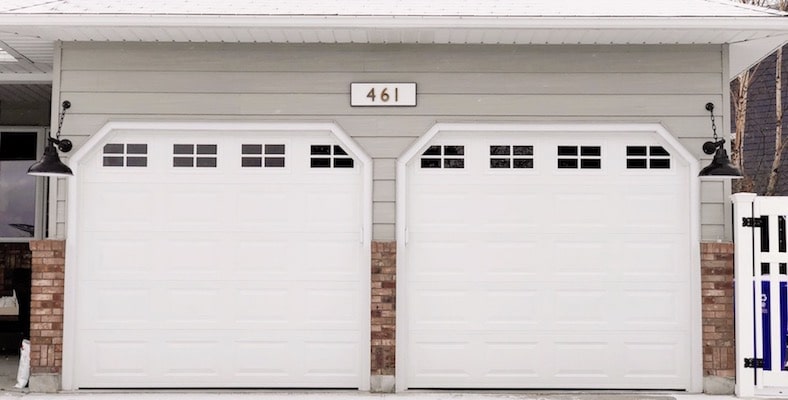
And here’s how they look now:

You can’t really tell from the before, but the doors we’ve had were in rough shape. Sometime before we bought the house the door on the left was nudged with a vehicle and was a bent out of shape. They were also commercial-grade doors, which are well-insulated, but all the weather stripping had disintegrated and the seals on the sides were warped so all that insulation wasn’t making much of a difference. Lots of cold air getting in. Yada yada, time to switch ’em out.
We hired some installers to put the doors in, and they agreed to let us document and share the process. They also give some really great tips that I think you will find helpful if you’re planning on tackling this project yourself. Though prices vary from area to area, here’s how it broke down for us:
Doors, rails, hardware etc. – ~$850 each (about $1700 total)
Professional installation – $140 per door ($280 total)
IMPORTANT NOTE: Please be advised that working with torsion springs can result in serious injury. Lowe’s can set you up with professional installation at the time of purchase, which is what we suggest if you are unfamiliar with this process. This project also uses Amarr Garage doors, supplied by Lowe’s. While some information may be specific to this situation, most of the tips are applicable across various installations.
Step 1. Remove the old torsion spring
The torsion spring connects to the door and helps it lift easier. There is a lot of tension on the spring, so be very careful as you remove it and take your time. Rushing through this part can result in serious injury.

1. Insert winding bar into the winding hole of the spring. Hold it tightly and loosen the screws to free the spring. Do not let go of the winding bar, and be sure to stand off to the side in case it gets away from you.
2. Slowly loosen the spring by lowering the winding bar (while keeping it pressed into the hole firmly), inserting another winding bar into the slot above it, transferring pressure to that hand, and removing the first winding bar. Repeat until the tension is relieved.
3. Unscrew the middle torsion spring support.
4. Remove the cables and disconnect the fittings for the torsion spring from the garage door track.
5. Remove the spring and discard. Do not keep and store old torsion springs, even if they are not broken. It’s safest to just throw them out.
Step 2. Remove the old door
Most garage door panels are light on their own, but can be awkward to maneuver and may lead to back injury. When in doubt, use the buddy system.

1. Unscrew the top half of each hinge.
2. Unscrew and remove the wheel from the top panel.
3. Lift the top panel out.
4. Remove remaining panels.
Step 3. Remove the old rails
If you are using new doors that are identical to the old, you can inspect your rails and potentially keep them in place if they are in good shape. If the doors are different, the rails should be removed and new rails that are meant for your new doors installed.

1. Detach the back screws/bolts.
2. Detach rails from the wall and discard.
Step 4. Prep hardware
I do this same thing whenever we have to put together IKEA furniture. Separate all of your hardware and take an inventory of the pieces you have. It will make the process go a lot faster once you actually get going.

Step 5. Prep the bottom panel
The bottom panel is the one with the weather strip on the bottom. Get everything set up on this panel first, and when you put it in place it will act as a guide for where to hang your rails.

1. Find the cable bracket and set it in place.
2. Lay out your wheel brackets. There should be one for each panel, with the shortest bracket going on the lowest panel, second shortest on the second and so forth. The wheel bracket for the bottom panel may look a little different (see #4 in this step).
3 & 4. Mount the cable bracket first, then the bottom panel wheel bracket over top the cable bracket (buckle up – I’m gonna use the word “bracket” a whole lot in this post).
5. Slide the wheel in place. It doesn’t attach to anything – it just floats in the slot.
Step 6. Prep the vertical rails
The rails mirror each other (one for the right side, one for the left). Make sure you have the rails oriented correctly before attaching the mounting brackets.

1 & 2. Use the group of three holes to orient the rails. The holes will be closer to the end at the bottom than they will be at the top.

1. Once oriented, attach the adjustable mounting brackets.
2. Attach the top mounting bracket.
Step 7. Attach the center hinges to the panels
Getting these attached now to each of the panels will help keep the doors steady while you’re putting them in place.

Step 8. Place the first two panels and (kind of) attach the vertical rails to the wall
The great thing about garage doors is, you want there to be some play between the wheels and the rails. That means you don’t need to use a measuring tape, except for initially placing the door.

1 & 2. Place the door and measure the right and left sides. Adjust so the door is centered.
3. Put the rail in place and attach the bottom mounting bracket to the wall (leave the top unattached for now). Again, double check that there is roughly 1/8-1/4in of wiggle room for the wheel.
4 & 5. Push the panel against the wall, pull the rail out from the wall as far as it will go (with the wheel in the track), and tighten the bottom adjustable mounting bracket. This will give the door another axis of wiggle room.
6. Add the next door panel, working the wheel into the rail, and attach the hinges.
Step 9. Add the remaining panels, except for the top

Step 10. Finish mounting the vertical rail and mount one side of the horizontal rail

1. Level the vertical rail and attach the top mounting bracket to the wall.
2. Using your shoulder to stabilize, loosely attach the horizontal rail to the vertical rail. Use a level to… well… make it level, and tighten.
3. Attach the mounting bracket for the torsion spring.
4. Don’t worry about the back end of the rail being attached. As long as you don’t hang on it or grab it and pull it down, it should be fine. That said, if your rails feel flimsy and like they are going to bend, you can take this opportunity to loosely connect the back end of the rail to keep it from sagging.
Step 11. Add the support beam (if applicable)
If your garage door has windows, it will likely come with a support beam so the door doesn’t flex and break as it opens and closes, day after day. Not all doors have them, but if yours does, you definitely need to use it. The beam should be installed on the top panel and connect to the garage door opener bracket.

1. The support beams are rarely cut to length, so you’ll probably need to trim it. Just cut it so it’s roughly 1/2in in from the edge of the door on each side.
2. Lay the beam in place so it sits at the top of the metal structure supports of the top panel.
3. Attach to the metal frame supports on the ends and center. Use self-tapping metal screws and don’t worry about going into one of the predrilled holes. Just get it secure.
4. Attach the garage door opener bracket (if applicable) so the top part of it overlaps the support beam, and put a self-tapping metal screw right through it into the metal frame support of the panel.
Step 12. Place the top panel, and add the remaining horizontal rail
Be sure that every time you add a panel, you attach the center and side hinges.

1. Lift the top panel and slide the wheel into the horizontal rail, rolling the panel downward into place.
2. Attach the horizontal rail on the other side, and secure the back ends of each horizontal rail.
Step 13. Secure the door
When you wind the torsion spring in the next step, there is the possibility that the spring is over wound and raises the door. In some cases, the door can shoot up and knock you off your ladder. Put a pair of vice grips on the rail to prevent the door from injuring you.

Step 14. Install the torsion spring
I’ll say it again – be careful! Take your time and stay out of the way of your winding bars in case they slip from your hand.

1. The red screws of the torsion spring will be on the left (when looking at the door from the inside). As a reference, whatever side has the red screws, the end of the coil should be pointing up.
2. Slide the spring and cable drum onto the bar, and slide the bar into the mounting brackets you previously attached in step 10. Attach the center support bracket to the wall (it needs to be in a stud).
3. Attach the cable to the cable drum and tighten the red screws on the cable drum. You’ll want to finger tighten first, then use a wrench to tighten an additional 1/2-3/4 turn on each screw. This will give you the tension you need to keep the drum from slipping, without damaging the bar.
4. Place a pair of vice grips on the bar, tightly, against the wall. This will keep the bar from spinning as you wind the spring.
5. Wind the spring starting with your winding bar in the bottom hole and lifting up, adding the other bar into the hole now at the bottom, transferring the tension to the bottom bar and lifting up. Do this until the spring is completely wound. The general guideline is one complete rotation of the spring for every foot of door height, + 1/2 rotation. Our doors are 8ft tall, so we did 8 full rotations and one additional half rotation.
Step 15. Add exterior weather strip (if desired – though I definitely recommend it)
Weather stripping can be very helpful in extreme climates to keep out cold, rain, dust and even bugs. Weather stripping should have screws about 2 inches from the end of each piece, and approximately 12 inches apart throughout.

There it is. There were also a couple funky things with our garage doors that we took this opportunity to address. More on that next week. Anyone else gearing up for garage improvements this Spring? I have to say, I’m super excited about everything we have planned and to turn this tight garage into something that works a little better for us.




Amazing informative article on how to replace your garage door. It’s really helped me a lot. Many many thanks for sharing with us this great article. Looking forward to getting more resource about the garage. Thanks.
Fantastic post, thank you!
Well written and detailed article. I hope it will help me alot in Garage door services as my garage door is making noise. Thankyou.
I’ve been in the industry for over a decade. What’s a “wheel bracket?”
You might want to brief your counsel on this post, as you could have blood on your hands if a homeowner decided to take on this task and as a result injure him/herself.
There are two schools of thought on that, and I can understand what you’re saying. But for the homeowner, who is likely unfamiliar with terms like “end bearing plate,” and “cable drum,” more descriptive terms tend to be more helpful. And I think we make it clear that this is not a project to take lightly, and if someone is unsure they should hire it out.
As being a garage door technician for 35 years, I hate seeing things like this, because it’s a recipe for someone to get hurt, first off you need to explain that the winding bars should be proper bars for winding and unwinding Springs ie. Hardened steel, secondly you forgot the part of leveling the first section and tracks so the door works properly