


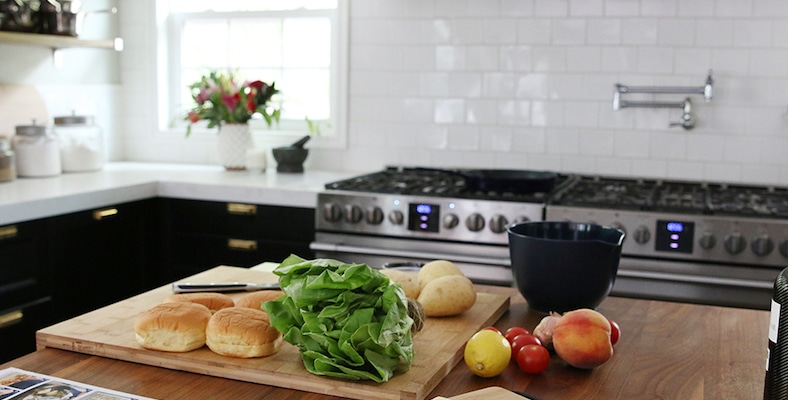
This post is sponsored by Blue Apron.

Since completing our kitchen remodel almost two years ago, we’ve received so many questions about keeping our cookware clean, since much of it is in view on our open shelving. Here’s one we received recently from one of our readers, Courtney:
“I’ve only been at this adulting thing for a couple of years (I turned 27 last week), but my inability to keep my cookware in a reasonable condition feels like my biggest failure. I’ve had cheap, expensive and in-between pots, pans and knives in nearly every type available and I am always frustrated with stains that refuse to come out, scrapes on the interior coating (which I immediately throw away out of fear of chemicals leaching into my food), rust, handles getting loose or breaking, etc. What am I doing wrong?!”
So for Courtney and everyone else out there who has the same question, we want to share a few details of the three more popular cooking materials, and how we keep ours clean and functional. Because we cook a lot.

Caring for Nonstick Cookware
It’s the case with all cookware, but especially nonstick, that keeping it in good condition starts with knowing its limits. Some view nonstick cookware as a way to avoid using oils and fats in cooking. Some see it as a way to make life easier and never worry about food sticking. But the suggested uses of nonstick cookware are pretty narrow, essentially including sweating vegetables and cooking eggs.

Nonstick cookware should not be used in an oven, and should always include oil of some kind. If you’re trying to keep your fat intake low, opt for cooking spray or heart-healthy fats like extra virgin olive. Add the oil when the pan is cool, and allow it to heat with the pan. Once you’ve had oil in the pan, you can add more as needed, depending on what you’re cooking. Nonstick pans are not recommended for deep frying or long-cooking of highly acidic foods, like tomatoes. When cooking tomatoes, 5-8 minutes is about as long as you want to keep them in a nonstick pan, so if you’re making a garden pasta, for example, add the tomatoes toward the end. Use another material for long-cooking sauces like marinara.

Nonstick cookware also doesn’t care for the harsh chemicals of a dishwasher. To keep the coating strong and scratch free, use only plastic and silicone utensils, and opt for a non-abrasive scrubbing sponge. I just use the purple or pink Scotch Brite brand sponges and they work great.

I often won’t even use dish soap, but if there are stuck on messes, a small drop of mild, liquid detergent works great.
Cleaning Stainless Steel Pots & Pans
One of the reasons so many people turn to nonstick cookware so much is because they’re frustrated with food that stubbornly sticks to stainless steel (that’s a mouthful). If it’s hard to scrape off, it’s hard to wash off, and we all just end up with a stack of stainless steel on our counters and in our sink, “soaking” for like 3 or 4 days. But the key to combatting this is not turning to another material, but understanding what it takes to prevent food from sticking to stainless steel. Answer? Preheating.

Remember these words when it comes to stainless steel: “Cold oil, hot pan.” I mentioned this trick several years ago in a post about roasting potatoes, but it applies to so many things, and it’s the same for sheet pans, frying pans and pots. Heat the cookware first, and add room temperature oil just before adding your food. This one trick will save so much frustration, both when it’s time to take the food off the pan, and when it’s time to wash the pan.
For a roasting pan, I like to coat my food with a small amount of oil, either using a bowl or zip top bag, before adding it to the preheated pan.

Once cooked, simply take the food off and allow the pan to cool before washing. Use a microfiber cloth to rub any spots off the outside of your cookware to keep them shiny. Here is an Anolon stainless steel pot I’ve used at least 5 times a week for nearly two years, and it shines like the day I bought it.

Now, with this I want to also address the fact that there are some food stains on stainless steel that don’t come out. At least not without crazy harsh chemicals that I wouldn’t want to use on something I’m putting my food in. So part of this is also recognizing which stains are actually impacting the quality of your food. A little discoloration in a pan is normal, and will come and go as you use your cookware. But if there’s something black and flaky, that’s the stuff you need to get rid of, even if it takes a bit of extra scrubbing.
Caring for Cast Iron Cookware
Cast iron is probably the most versatile and sturdy kinds of cookware, and historically has been viewed as the easiest to maintain. The way humans live has changed drastically over the centuries, and we now use soap to clean everything. But cast iron does not like soap, so we see it as different and demanding. But really, it’s all about understanding the material.

Cast iron is porous, which means it takes on parts of whatever sits in it. That means that flavor from every burger, chicken breast, steak, vegetable, cobbler, and cake you cook in it, sticks around for awhile. Unfortunately, this is also true with nonfood things, like soap. But a well-cared-for cast iron pan will clean easily, with little work and no soap required.

How you clean cast iron depends on what the food leaves behind. If there is nothing stuck to the pan, simply wipe it out with paper towel. If you find there is some stuck on food or even sticky grease, the more commonly recommended procedure is to add coarse salt to the pan and scrub with a rag until the pieces come off. For me, that often takes a bit too long and doesn’t come as clean as I’d like, so I follow these steps:
1. Wipe out any excess liquid or grease.

2. Fill the bottom with water and bring to a simmer until stuck on bits come off easily.

3. Drain water and wipe dry. Add cooking oil to the pan and put it back on medium low heat for 15 minutes.

4. Allow the pan to cool, then wipe out excess oil with paper towel and store.

The most important thing for cast iron is that it has the seasoning, which is essentially a layer of oil that protects it from oxidation and rust. It also keeps the cookware naturally non-stick.


Your cookware are your tools in the kitchen. Having tools that are in good working order is one of the best things you can do to enjoy the time you spend in your kitchen, and the food that comes out of it.
And of course the other side of that equation is knowing what to cook! We’ve used Blue Apron for years now and can’t say enough about how much we love it (the White Cheddar Pork Burgers prepared in this post were so legit). Blue Apron sends all of the farm-fresh ingredients you need, perfectly portioned, along with recipes, to make amazing meals in your own home. The meals can be prepared in 40 minutes or less and almost every one of them introduces us to new ingredients we can’t find locally, or new ways of using ingredients that we can.
Right now, Blue Apron is offering three free meals to the first 50 of our readers who make their first order. CLICK HERE to get claim it and be sure to let us know what you think when you try it! We’ve been sharing this service with our readers for years now and love hearing your favorite things about it.



Thank you for this informative post. The craze about nonstick pans led me to buying a T-fall hard anodized one. It has served me well until it started chipping. I was worried so much about my safety until I stopped using it.
On inquiry, I learnt that my misgiving was using the pan in an oven. But still, I would want to get your opinion about nonstick/Teflon safety. Thank you
Thank you for the informative post! what brand is best for cast iron cookware
Staub is my favorite, with Le Creuset as a close second. Martha Stewart from Macy’s is the best budget option IMO
I’ve referred to this post so many times, after not really knowing how to care for my cast iron skillet now I follow this method and it’s always in beautiful condition. Thank you for sharing this with us.
Thanks for the informative post!
I feel like I really want to invest in a cast iron pan, but am so scared that I’m going to chip my quartz counters if I accidentally knock it against when I’m washing or putting it away. Is that weird?
Not at all. Though, I find if you’re mindful of it (which you are) then you’re a lot less likely to have it happen.
I am looking at upgrading our cookware. What brands or specific pans would you recommend purchasing?
We are big fans of the Anolon Nouvelle Copper Stainless Steel and non-stick line.